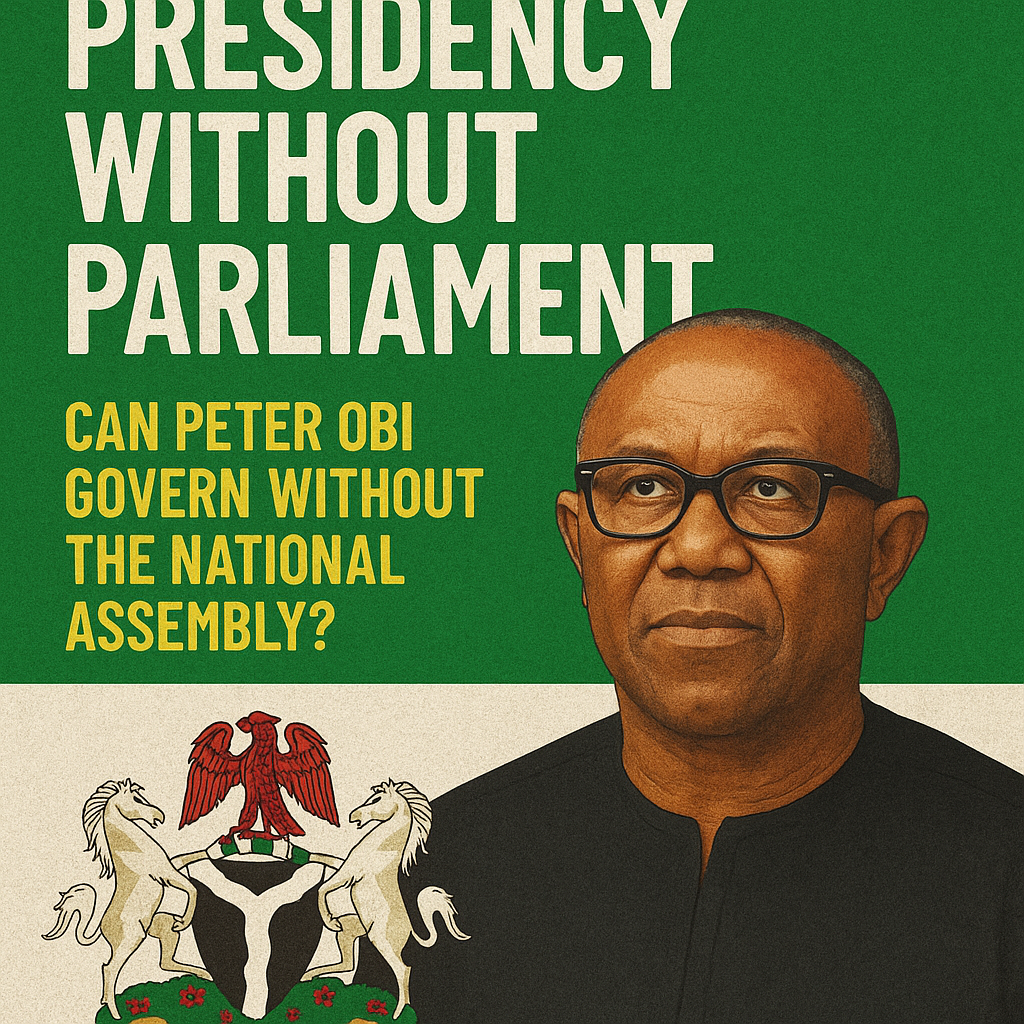
Nigeria’s political landscape is buzzing with speculation about Peter Obi’s potential presidency in 2027, possibly under the African Democratic Congress (ADC). For many, especially the youth and the politically disenfranchised, Obi represents a fresh start, a technocrat poised to steer a nation yearning for change. Yet, amid this excitement lies a critical question: What happens if Obi wins the presidency but faces a National Assembly dominated by entrenched APC loyalists or bitter PDP veterans? Peter Obi becomes a president without a parliament, a reformer trapped in a hostile chamber.
The Nigerian System: A Triad of Power
Nigeria operates under a federal presidential system, where power is split among three branches:
- Executive: Led by the president, who implements laws and oversees government operations.
- Legislative: The National Assembly (Senate and House of Representatives), which makes laws, approves budgets, and checks executive authority.
- Judicial: The courts, which interpret laws and ensure constitutional adherence.
The Nigerian Constitution mandates this separation of powers, ensuring no branch can dominate unchecked. For a president like Peter Obi, this means that governing without the National Assembly’s cooperation is not just difficult—it’s constitutionally unfeasible.
The National Assembly holds key powers:
- Legislation: Passing laws to enact reforms or policies.
- Budget Approval: Authorizing funds for government programs.
- Appointments: Ratifying ministerial and other key nominations.
Without legislative backing, a president’s agenda stalls. Obi could win the presidency with a wave of popular support, but if the National Assembly remains hostile, his reforms whether economic, electoral, or structural would be dead on arrival.
Historical Precedents: Lessons from the Past
History underscores this reality. During military regimes, Nigeria saw governance without a legislature, as rulers issued decrees unchecked. But these were authoritarian, not democratic, systems, often marked by instability and abuses hardly a model for Obi, a champion of democracy.
In a democratic context, consider Muhammadu Buhari’s tenure (2015–2023). Despite an APC majority in the National Assembly, internal fractures delayed budgets, stalled appointments, and slowed his “Change Agenda.” Obi’s situation could be direr: without even a nominal majority, he might face outright obstruction from APC or PDP lawmakers loyal to rival interests.
Peter Obi’s Approach: A Democratic Pragmatist
Peter Obi, a former Anambra State governor and 2023 LP presidential candidate, has built his reputation on transparency, accountability, and the rule of law. His governorship succeeded despite his party lacking a single seat in the state assembly, a feat he attributes to integrity and collaboration with lawmakers. This suggests Obi values working within democratic structures, not bypassing them.
An Obi presidency without National Assembly support would clash with his principles. Attempting to govern unilaterally say, through executive orders has limits:
- Scope: Executive orders can’t replace legislation or budgets.
- Judicial Oversight: Courts could strike down overreaches.
- Political Cost: Such moves might spark unrest or impeachment threats, undermining his legitimacy.
A Hostile National Assembly: What Could Happen?
Imagine 2027: Obi wins the presidency, but the National Assembly is controlled by APC loyalists or PDP veterans. Here’s how they could thwart him:
- Blocked Appointments: The Senate delays or rejects his ministerial picks, crippling his administration.
- Legislative Gridlock: Reform bills (e.g., police or electoral changes) get buried or mangled in committees.
- Budget Sabotage: Lawmakers slash funding for Obi’s priorities or pad budgets for their own interests.
- Public Attacks: Hearings become platforms to smear his image.
- Impeachment Noise: Even baseless threats could paralyze his momentum.
This isn’t hypothetical, it’s Nigeria’s political reality, where legislative elections favor incumbents with local patronage and “godfathers.” A presidential win doesn’t guarantee legislative alignment, leaving Obi potentially isolated.
Can He Govern Without Them?
Technically, no. The constitution ties the president’s hands without legislative cooperation. Practically, any attempt to sidestep the National Assembly would trigger:
- Legal Challenges: The judiciary could intervene.
- Public Backlash: Nigerians might resist perceived authoritarianism.
- International Pressure: Global partners could pull support.
Obi’s own experience in Anambra shows he’d likely seek to negotiate and build coalitions, not rule alone. But without a supportive legislature, his ambitious reforms would stall, turning hope into frustration.
Institutional Reforms Must Begin in the Party
The threat of obstruction is also a call for party reform within ADC itself. As new actors pour in, some from discredited APC or PDP backgrounds there is a risk that ADC becomes a shell for opportunists. If ADC wants to govern differently, it must legislate differently and that begins by transforming how it recruits and vets candidates.
Every legislative candidate under ADC must be subjected to public screening, debates, and disclosure of assets and criminal records. This is the only way to prove that the party is not a recycled vessel.
Likewise, Obi must surround himself with not just loyalists, but technocrats who can think politically. The presidency is not a boardroom. It’s a battlefield and the National Assembly is the frontline.
Conclusion: Power Is Not Enough. Strategy Is Everything.
To govern without the National Assembly is to govern in theory, not in fact.
Peter Obi cannot govern Nigeria effectively without the National Assembly. It’s not just a matter of power, it’s the law, baked into Nigeria’s democratic framework. His vision, rooted in good governance, depends on legislative buy-in to translate into action. A hostile or indifferent National Assembly would render him a president in name only, trapped by gridlock and unable to deliver.
For Obi and the ADC, the lesson is clear: winning the presidency isn’t enough. The real fight is for the 360 federal constituencies and 109 senatorial districts. Without a strategy to secure legislative support through credible candidates, coalitions, or public pressure, Obi’s presidency risks being a noble dream with no engine to drive it. In Nigeria, power without structure is no power at all.
In the end, Peter Obi’s real challenge is not just to win the presidency. It is to win the right to govern. That right is conferred not merely by votes but by the ability to shape laws, marshal alliances, and drive national consensus.
If the Obidient movement and ADC fail to understand this, they will walk into the same trap that reformers before them walked into: presidency without power, vision without implementation, and hope without structure.
To avoid this fate, the time to act is now. Because by 2027, it may be too late.
